Why Study in Ireland: Education System & Opportunities
Ireland’s education system ranks among the top 20 globally, with a reputation for excellence in research and innovation. The country hosts several prestigious universities, including Trinity College Dublin and University College Dublin, which consistently rank in global top 200 lists.
Educational Advantages
- English-language instruction at all levels
- Internationally recognized qualifications
- Strong industry connections and internship opportunities
- Research-focused academic environment
- Student-centered teaching approach
Post-Study Benefits
- Third Level Graduate Scheme allowing 1-2 years stay after graduation
- Access to EU job market
- Potential pathway to permanent residency
- Vibrant startup ecosystem for entrepreneurs
- Strong presence of multinational companies

Ready to Begin Your Irish Education Journey?
Explore Ireland’s top universities and find the perfect program for your academic goals.
University Admission Process: Step-by-Step Guide
Securing admission to an Irish university is the first crucial step in your study abroad journey. The process varies slightly between institutions, but generally follows these steps:
- Research Programs and Universities – Explore courses that match your academic background and career goals. Ireland offers programs in various fields including technology, business, medicine, humanities, and sciences.
- Check Entry Requirements – Review specific academic prerequisites, English language proficiency requirements, and any program-specific criteria.
- Prepare Application Documents – Gather all required documents including academic transcripts, personal statement, recommendation letters, and CV.
- Submit Application – Apply directly through the university’s online portal or through the Central Applications Office (CAO) for undergraduate courses.
- Receive Offer Letter – If successful, you’ll receive an offer letter which you’ll need for your visa application.
- Pay Deposit – Secure your place by paying the required deposit (usually deducted from your total tuition fee).
Required Documents for University Application
| Document | Details | Special Requirements |
| Academic Transcripts | Complete records of previous education | Translated and notarized if not in English |
| English Proficiency Test | IELTS (min. 6.5), TOEFL (min. 90), or equivalent | Test must be taken within last 2 years |
| Statement of Purpose | Essay explaining motivation and goals | 500-1000 words, program-specific |
| Recommendation Letters | 2-3 letters from academic references | On official letterhead with contact details |
| CV/Resume | Academic and professional background | Chronological format preferred |
| Portfolio | For art, design, architecture programs | Digital format, following program guidelines |
Key Application Deadlines for 2024 Intakes
| Intake Period | Application Deadline | Visa Application Timing |
| September 2024 (Main intake) | Non-EU: April-May 2024 (varies by university) | 3 months before course start |
| January 2025 (Limited programs) | Non-EU: October-November 2024 | 3 months before course start |
| May 2025 (Summer programs) | Non-EU: February-March 2025 | 3 months before course start |

Ready to Apply to Irish Universities?
Start your application process with Ireland’s centralized application system for higher education.
Ireland Student Visa Application Process
After securing admission to an Irish institution, international students from non-EU/EEA countries must obtain a student visa. The process requires careful preparation and attention to detail.
Types of Irish Study Visas
Short Stay ‘C’ Study Visa
- For courses lasting up to 90 days
- Cannot be extended within Ireland
- No permission to work
- Suitable for summer programs or short courses
Long Stay ‘D’ Study Visa
- For courses lasting more than 90 days
- Allows part-time work (20 hours/week during term)
- Can be renewed annually
- Required for degree programs
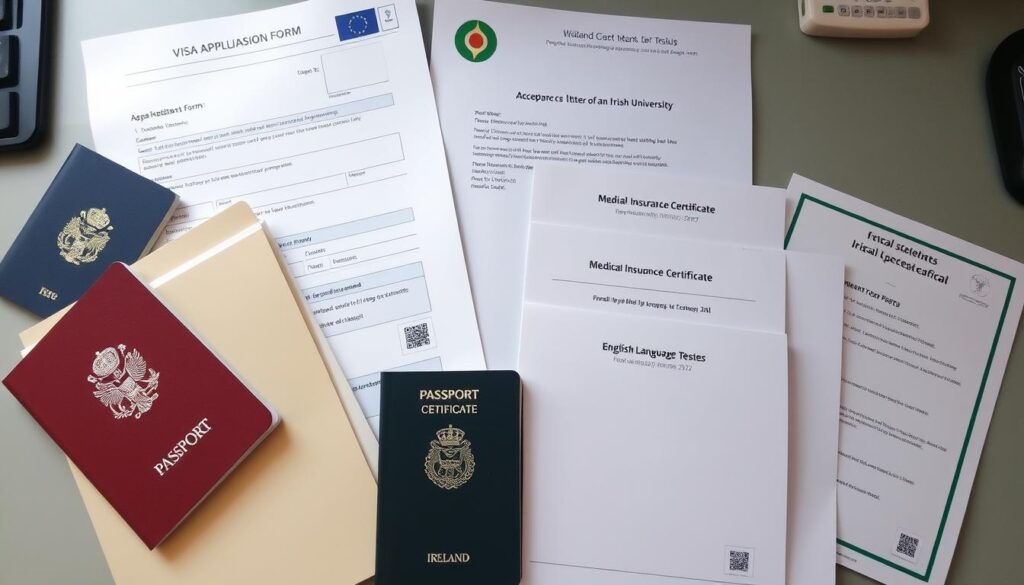
Required Documents Checklist
| Document | Requirements | Notes |
| Completed Online Application | Via AVATS (Automated Visa Application Tracking System) | Print and sign the summary sheet |
| Passport | Valid for at least 12 months after intended departure from Ireland | Include copies of previous visas |
| Passport Photos | Two recent passport-sized photos | Must meet Irish photo requirements |
| Letter of Acceptance | From recognized Irish educational institution | Must be on official letterhead |
| Proof of Tuition Payment | Receipt for at least €6,000 or full payment if less | Electronic Transfer of Funds (ETF) confirmation |
| Proof of Finances | Access to minimum €7,000 per year (plus tuition) | Bank statements for past 6 months |
| Private Medical Insurance | Minimum coverage of €25,000 | Must cover hospitalization |
| English Language Proficiency | IELTS (min. 5.0) or equivalent | Certificate must be less than 2 years old |
| Application Letter | Explaining purpose of study in Ireland | Include study and career plans |
| Accommodation Details | Proof of arranged accommodation in Ireland | Rental agreement or university housing confirmation |
2024 Update: From June 30, 2025, financial requirements for non-visa required nationals will increase to €10,000 for courses over 8 months and €833 per month for shorter courses, aligning with requirements for visa-required nationals.
Visa Interview Preparation Tips
Do’s
- Research your program thoroughly
- Prepare clear explanations for course choice
- Demonstrate ties to your home country
- Show understanding of visa conditions
- Bring additional supporting documents
Don’ts
- Provide inconsistent information
- Show uncertainty about study plans
- Mention intent to work full-time
- Appear unprepared for financial questions
- Submit incomplete documentation
Visa Processing Time and Fees (2024)
The Ireland student visa processing time is approximately 8 weeks, though this can vary based on your country of residence and application volume. Plan to apply at least 3 months before your intended travel date.
| Fee Type | Amount | Notes |
| Single-Entry Visa | €60 | Non-refundable |
| Multi-Entry Visa | €100 | Recommended for students planning to travel |
| Immigration Registration (IRP Card) | €300 | Paid after arrival in Ireland |
Ready to Apply for Your Ireland Student Visa?
Start your online visa application through the official Irish immigration portal.
Scholarships & Financial Planning
Financing your education in Ireland requires careful planning. Fortunately, numerous scholarship opportunities are available for international students, alongside reasonable tuition fees compared to other English-speaking destinations.
Government-Funded Scholarships
Government of Ireland International Education Scholarships
This prestigious program offers 60 scholarships annually for high-achieving international students. Each scholarship provides:
- €10,000 stipend for one year of study
- Full tuition fee waiver
- Available for both undergraduate and postgraduate programs
Application period: January-March annually
Irish Aid Fellowship Programme
Aimed at students from developing countries, this program supports:
- Full tuition fees
- Monthly stipend
- Return airfare
- Health insurance
- Settlement allowance
Application period: September-November annually
University-Specific Scholarships
| University | Scholarship Name | Value | Eligibility |
| Trinity College Dublin | Global Excellence Scholarship | €5,000 – €10,000 | Academic merit-based |
| University College Dublin | Global Excellence Scholarship | 25-100% tuition fee reduction | Academic excellence |
| University College Cork | International Student Scholarship | €10,000 | High academic achievers |
| Dublin City University | International Student Scholarships | 50% tuition reduction | Academic merit |
| National University of Ireland Galway | International Excellence Scholarship | €2,000 – €3,000 | Based on final grades |
Average Tuition Fees by Course Type (2024)
| Program Level | Arts & Humanities | Business & Law | Science & Engineering | Medicine & Health |
| Undergraduate | €10,000 – €16,000 | €12,000 – €18,000 | €14,000 – €20,000 | €18,000 – €55,000 |
| Postgraduate | €12,000 – €18,000 | €14,000 – €25,000 | €15,000 – €24,000 | €20,000 – €35,000 |
| PhD | €10,000 – €16,000 | €10,000 – €16,000 | €10,000 – €18,000 | €10,000 – €20,000 |
Additional Costs to Consider: Beyond tuition, budget approximately €10,000-€15,000 annually for accommodation, food, utilities, transportation, books, and personal expenses. Dublin is typically more expensive than other Irish cities.
Find Scholarships for Your Studies in Ireland
Explore the comprehensive database of scholarships available for international students.
Part-Time Work Rules for International Students
Working part-time while studying can help offset living expenses and provide valuable work experience. Ireland allows international students to work under specific conditions.

Weekly Hour Limits
| Period | Maximum Hours | Notes |
| Term Time | 20 hours per week | Strictly enforced |
| Holiday Periods | 40 hours per week | June, July, August, September, and December 15 to January 15 |
Important: Working beyond permitted hours violates visa conditions and can result in deportation. Employers may face penalties for allowing students to work excessive hours.
Popular Student Job Sectors
Hospitality
- Restaurants and cafés
- Hotels and hostels
- Bars and pubs
- Tourism services
- Average pay: €11-14 per hour
Retail
- Supermarkets
- Clothing stores
- Shopping centers
- Convenience stores
- Average pay: €11-13 per hour
Campus Jobs
- Library assistants
- Administrative support
- Research assistants
- IT support
- Average pay: €12-15 per hour
Tech & Startups
- Customer support
- Content creation
- Social media management
- Data entry
- Average pay: €13-18 per hour
Tax Registration Process
- Apply for a Personal Public Service (PPS) Number – This is Ireland’s social security number, required for employment and taxation.
- Register with Revenue – Complete a Form 12A to register for tax purposes.
- Understand the Tax Credit System – International students are entitled to certain tax credits that reduce tax liability.
- File Annual Tax Returns – If required, submit Form 11 or Form 12 by the annual deadline.
Apply for Your PPS Number
Start the process to obtain your Personal Public Service Number for working in Ireland.
Post-Study Settlement Pathways
Ireland offers attractive post-study options for international graduates, making it possible to gain valuable work experience and potentially settle permanently.

Third-Level Graduate Scheme
| Qualification Level | Stay Duration | Visa Type | Work Rights |
| Level 8 (Honours Bachelor Degree) | 12 months | Stamp 1G | Full-time work permitted |
| Level 9 (Master’s Degree) | 24 months | Stamp 1G | Full-time work permitted |
| Level 10 (Doctoral Degree) | 24 months | Stamp 1G | Full-time work permitted |
The Third-Level Graduate Scheme (Stamp 1G) allows graduates to remain in Ireland to seek employment and gain valuable work experience. During this period, you can work full-time without requiring a work permit, giving you time to secure long-term employment.
Critical Skills Employment Permit
After finding employment, international graduates can transition to a work permit. The Critical Skills Employment Permit is particularly advantageous:
- Designed for high-demand occupations
- Minimum annual salary requirement of €32,000 (for recent graduates in eligible fields)
- Fast-track to long-term residency (after 2 years)
- Immediate family reunification
- No labor market needs test required

Permanent Residency Pathways
Stamp 4 Permission
After 5 years of legal residence in Ireland (2 years for Critical Skills permit holders), you may qualify for Stamp 4 permission, which:
- Allows unrestricted work rights
- Does not require employment permits
- Must be renewed every 5 years
- Serves as a stepping stone to citizenship
Irish Citizenship
After 5 years of legal residence (including 1 year of continuous residence immediately before application), you may apply for Irish citizenship, which offers:
- Permanent right to live and work in Ireland
- EU citizenship benefits
- Visa-free travel to numerous countries
- Right to vote in all elections
Explore Work Permit Options
Learn more about transitioning from student to worker status in Ireland.
Frequently Asked Questions
Can I bring family members on an Ireland study visa?
Generally, immediate family members (spouse and dependent children) can accompany students pursuing PhD programs or government-sponsored students. Master’s and undergraduate students typically cannot bring dependents initially but may apply for family reunification after establishing themselves in Ireland. Each family member requires their own visa application and must demonstrate sufficient financial resources beyond those required for the student.
What happens if my student visa application is refused?
If your Ireland student visa is refused, you’ll receive a letter explaining the reasons. You have two options: address the issues and submit a new application, or appeal the decision within two months of receiving the refusal letter. Appeals should include additional documentation addressing the specific reasons for refusal. Common refusal reasons include insufficient funds, incomplete documentation, unclear study purpose, or immigration history concerns.
Can I extend my student visa if I want to continue studying?
Yes, you can extend your student permission in Ireland if you wish to pursue further studies. For students pursuing courses up to NFQ Level 8 (Bachelor’s degree), you can extend your residence permit annually for a maximum of 7 years. For those pursuing NFQ Level 9 and above (Master’s and PhD), extensions can be granted every two years for a maximum of 8 years. You must maintain your full-time student status, have good academic standing, and meet financial requirements to qualify for extensions.
Conclusion: Your Path to Studying in Ireland
Ireland offers international students a unique combination of world-class education, rich cultural experiences, and excellent post-study opportunities. By following this comprehensive guide, you’ll be well-prepared to navigate the admission process, secure your student visa, manage your finances, and potentially build a future in Ireland after graduation.
Remember that preparation is key—start your application process early, ensure all documentation is complete and accurate, and maintain clear communication with your chosen institution throughout the process. With careful planning and the right approach, your Irish education journey can be the foundation for a successful international career.
Begin Your Irish Education Journey Today
Get personalized guidance on studying in Ireland from official education advisors.